In this guide
Berlin’s public transportation network — operated by the Berliner Verkehrsbetriebe (BVG) and the national railway's S-Bahn Berlin — is universally celebrated as one of the most comprehensive, affordable, and punctual transit systems in Europe. Whether you are traveling at 2:00 PM or 4:00 AM, you are rarely more than a five-minute walk from a subway station, tram stop, or bus route.
However, the system operates on a «proof of payment» honor system with no turnstiles or ticket barriers at station entrances, leading thousands of tourists every year into costly validation fines. In this comprehensive 2026 guide, we break down Berlin’s tariff zones, ticket pricing, transit apps, and the golden rules of riding the rails like a local.
1. Understanding the BVG Tariff Zones: A, B, and C
Berlin is divided into three concentric fare zones. Knowing which zone your destination lies in is critical to buying the correct ticket:
| Zone | Coverage Area | Key Landmarks Included |
|---|---|---|
| Zone A | The inner city core, bounded by the elevated S-Bahn Ringbahn (Circle Line). | Mitte, Alexanderplatz, Brandenburg Gate, Museum Island, Kreuzberg, Friedrichshain. |
| Zone B | The outer city districts up to the official Berlin municipal boundary. | Charlottenburg Palace, Teufelsberg, Spandau Citadel, Grunewald Forest. |
| Zone C | The surrounding state of Brandenburg within 15 km of Berlin. | Berlin Brandenburg Airport (BER), Potsdam (Sanssouci), Sachsenhausen Concentration Camp. |
The Airport Trap: 90% of all tourist transit fines in Berlin happen on the way to or from BER Airport. The airport is located in Zone C. If you purchase a standard Berlin AB ticket, you are traveling without a valid ticket the moment your train crosses into Zone C. You must always purchase a Berlin ABC ticket when traveling to/from the airport!
2. Ticket Types & Fares (2026 Pricing)
You can buy transit tickets at touchscreen vending machines on any station platform (available in English, Spanish, and German) or directly inside the official BVG Fahrinfo or BVG Jelbi smartphone apps:
- Einzelfahrschein (Single Ticket - 3.50 € AB / 4.40 € ABC): Valid for 2 hours across all trains, trams, and buses in one direction. You may transfer between lines as much as you like, but round-trips and return journeys back to your starting point are strictly prohibited on a single ticket.
- Kurzstrecke (Short Trip - 2.40 €): Valid for up to 3 stops on the U-Bahn or S-Bahn (transfers allowed), or up to 6 stops on buses and trams without transfers.
- 24-Stunden-Karte (24-Hour Pass - 9.90 € AB / 11.40 € ABC): Unlimited rides for one person for a rolling 24-hour period from the moment of validation. If you plan to make 3 or more trips in a single day, this pass pays for itself immediately.
- 24-Stunden-Karte Kleingruppe (Small Group 24-Hour Pass - approx. 31.00 € AB / 33.00 € ABC): Valid for up to 5 people traveling together for 24 hours. Incredible value for families and groups of friends.
- The Deutschlandticket: If you are staying in Germany for several weeks or traveling onwards to Munich, Hamburg, or Cologne, the national monthly transit subscription covers all local and regional trains (RE, RB, S-Bahn, U-Bahn, trams, buses) nationwide.
3. The Golden Rule: Validating Your Ticket («Entwerten»)
This is the single most important rule of public transit in Germany: buying a physical paper ticket does NOT make it valid for travel!
Before stepping onto any train or subway car, you must insert your paper ticket face-up into the small red or yellow mechanical stamping box located on the platform (or mounted on the grab bars inside buses and trams). The machine stamps the date, time, and station code with a sharp metallic «clack» sound. If you board a train with an unstamped ticket, plainclothes transit ticket inspectors (Fahrkartenkontrolleure) will show their badges and issue an immediate, non-negotiable 60 € penalty fare on the spot.
4. Modes of Transit: U-Bahn, S-Bahn, Trams & Buses
- U-Bahn (Underground Metro, Yellow Trains): 9 lines (U1 to U9) crisscrossing the city underground. Trains arrive every 3 to 5 minutes during peak hours.
- S-Bahn (Suburban Rail, Green «S» Logo): 16 lines running above ground and through express tunnels. Crucial lines include the Stadtbahn (S3, S5, S7, S9 cutting east-west through Central Station) and the Ringbahn (S41 clockwise, S42 counter-clockwise circling the city core).
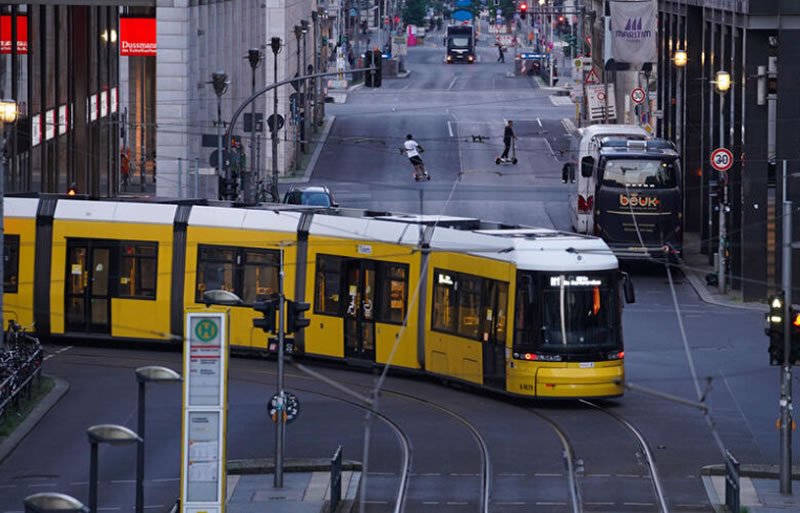
- Trams (Straßenbahn / MetroTram): Primarily serving former East Berlin neighborhoods (Prenzlauer Berg, Friedrichshain, Mitte). M-lines (like M10, the famous «party tram») run 24/7.
- Bus 100 & Bus 200 (The Secret Sightseeing Route): Instead of paying 30 € for a commercial hop-on hop-off tourist bus, board public double-decker Bus 100 at Alexanderplatz. Grab a front-row seat on the top deck for the price of a normal single ticket as it drives past Berlin Cathedral, Museum Island, Unter den Linden, Brandenburg Gate, the Reichstag, Victory Column, and Zoo Station.
5. Weekend Night Transit: 24/7 Service
Berlin is world-renowned for its round-the-clock nightlife, and its transit system is built to support it. On Friday and Saturday nights (as well as nights before German public holidays), all major U-Bahn and S-Bahn lines run continuously 24 hours a day at 15-minute intervals. On Sunday through Thursday nights, replacement night buses (marked with an «N» prefix, e.g., N2, N8) mirror subway routes through the dawn hours.